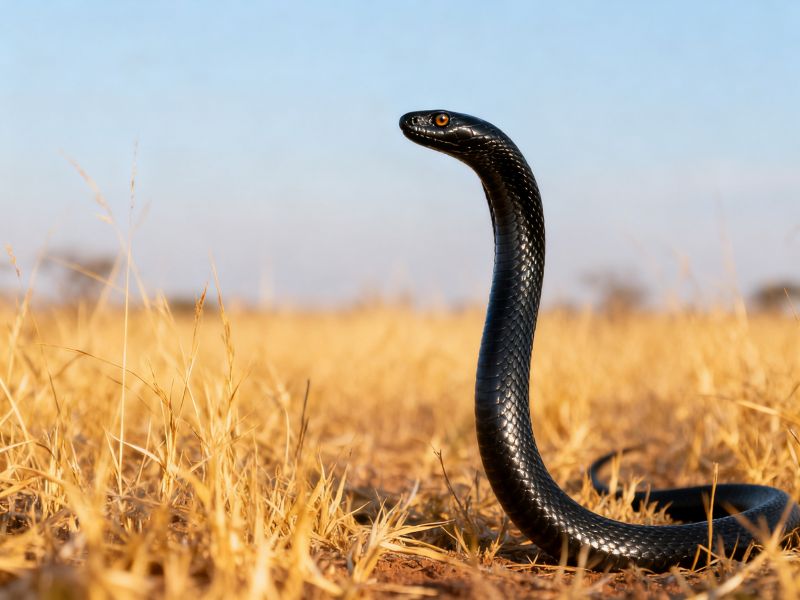
A black mamba can lift a third of its body off the ground, open a mouth as dark as wet charcoal。and deliver enough neurotoxic venom to kill an adult human within hours. That image explains the fear. It also explains why so many descriptions of the Mamba slide into exaggeration. The species, Dendroaspis polylepis, is not black at all;its scales range from olive to gunmetal grey, and the name comes from the inky lining of its mouth. A large specimen may exceed 4 metres, though 2 to 2.5 metres is far more typical. The Mamba is Africa's fastest land snake, capable of short bursts near 12 km/h, not the 20 km/h figure repeated in warnings and clickbait videos. It can strike high and fast, and its venom can kill. That is enough. The Mamba does not need embellishment. Rangers in Limpopo sometimes find one basking on a warm rock at dawn, then return an hour later to an empty patch of grass. A snake that would rather vanish into a termite mound does not deserve a reputation built on horror-film pace and invented aggression.Field accounts make the Mamba look less like a pursuer and more like a nervous specialist. It favours savanna, rocky outcrops, and dry woodland where it can retreat into holes, crevices, or abandoned termite mounds. In Kruger National Park, rangers often find the snake near water in the dry season, but they rarely see it for long. One guide's description stuck with me: a grey rope crossing the track, then nothing. That is the usual encounter. The Mamba raises its head to scan, not to chase. When cornered, it may spread a narrow hood。gape, and strike with unnerving accuracy;when given space, it takes the exit. I have watched enough wildlife footage to distrust the phrase aggressive snake. Defensive, yes. Aggressive, rarely. The Mamba's first instinct is escape, and its second is a warning display that gives a sensible observer time to back away. Most bites begin with a human decision, not a snake plan.Venom is where the Mamba earns real respect. Its bite injects a fast-acting cocktail of neurotoxins and cardiotoxins that can cause tingling, drooping eyelids, sweating, difficulty swallowing。and eventually respiratory failure. Untreated cases are catastrophic;
antivenom changes the outcome, but it must be given in a hospital with airway support, not in a village hut by flashlight. South Africa's SAIMR polyvalent antivenom is commonly used, and access remains uneven across rural Africa. Bites are still uncommon. The Mamba avoids people, and most strikes happen when someone steps on it, tries to kill it, or corners it in a shed. The epidemiology matters: a snake that bites only under extreme pressure is not a monster on patrol. It is a risk that becomes manageable when people stop treating every sighting as a duel. A Mamba bite is a medical emergency, but a Mamba sighting is not;that distinction should be taught in every lodge and farm school. The Mamba's venom is formidable;
human panic is often the accelerant. A clear head and a phone call do more than a heroic swing with a stick.Captive observations add another layer. In well-designed enclosures, the Mamba is alert, curious。and quick to retreat. Keepers describe a snake that tracks movement with a raised head and tastes the air, not one that hurls itself at glass. Poorly kept specimens become stressed, and stress can look like aggression. That distinction gets lost in social media clips, where a gaping Mamba is framed as an attack. I find those clips tedious. They flatten a complex animal into a jump scare. The Mamba's speed is real, its venom is real, and its warning display is real;the myth that it hunts humans is not. A useful rule for travellers is simple: look at your feet, use a light at night, and never reach into a hole. The Mamba will do the same courtesy and leave. That is not passivity. It is a survival strategy honed over millions of years, and it works better than the stories we tell.Conservation has a stake in correcting the record. The Mamba is not a species that benefits from fear. Persecution, habitat fragmentation, and roadkill remove snakes that control rodents and occupy a narrow ecological role. Education works better than a machete. In parts of KwaZulu-Natal, snake handlers and clinics have reduced panic by teaching people to identify the Mamba, call for help, and keep a safe distance. That practical work rarely makes headlines because it lacks spectacle. Still, it is how coexistence actually happens. The Mamba can be lethal and unremarkable at once: a fast, shy predator with a bad press agent. A Mamba does not guard territory the way a lion does;it simply exists in a landscape that is shrinking. Treat it with distance。not mythology. The snake has survived without our admiration;
it may not survive our misinformation and our blades. A little accuracy would help both sides.